
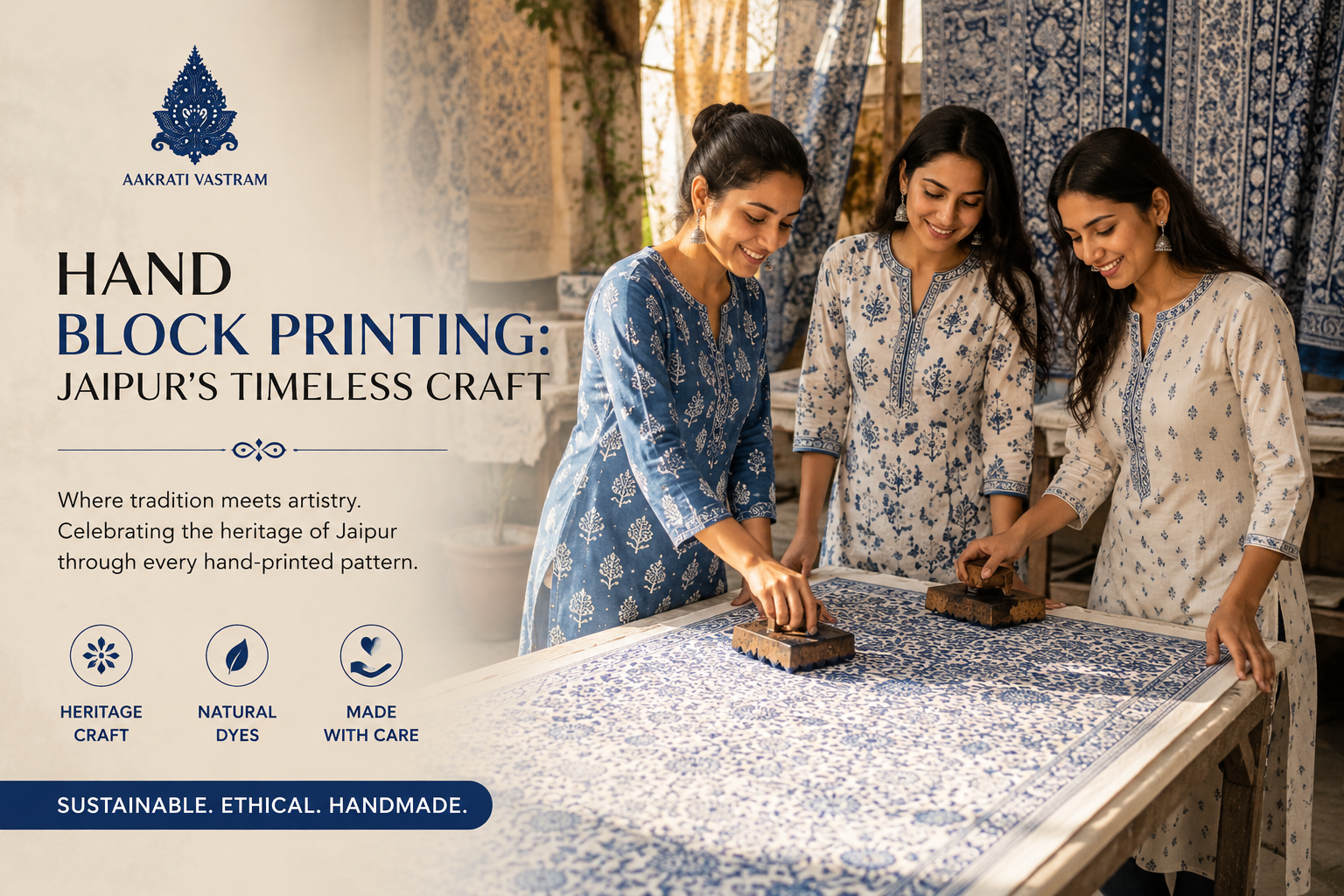
Hand block printing is not just a textile technique; it is a living heritage of Rajasthan. For over 500 years, skilled artisans have been creating stunning fabrics using carved wooden blocks, natural dyes, and incredible precision. Whether you are looking for a hand block print kurta, exploring jaipur block prints, or want to understand sanganeri hand block printing, this guide covers everything you need to know.
From the history of block printing rajasthan to practical tips on identifying authentic rajasthani block print, and introducing you to Aakrati Vastram a brand making India's most popular hand block print clothing for women – consider this your complete resource.
What is Hand Block Printing? A Quick Overview
Hand block printing is a traditional method of fabric decoration where designs are carved onto wooden blocks, dipped in dye, and hand-stamped onto cloth. Each color in the design requires a separate block. The result is a fabric that is unique, breathable, and full of character.
Why is it special?
-
✅ Every piece is handmade – no two are identical.
-
✅ Uses eco-friendly dyes (natural or AZO-free synthetic).
-
✅ Supports rural artisan communities.
-
✅ Timeless aesthetic that works for ethnic and fusion wear.

The Rich History – Where Did It All Begin?
Hand block printing traces its roots back over 2,000 years, but in Rajasthan, it has flourished for approximately 500 years.
-
Origin in Bagru Village: The Chhipa community first developed this craft in Bagru, near Jaipur. They are known for dabu (mud resist) printing and natural vegetable dyes.
-
Spread to Sanganer: Later, the art moved to Sanganer (near Jaipur), where artisans began using AZO-free synthetic pigments for brighter, colorfast prints.
-
Jaipur as the Hub: Today, jaipur block printing is world-famous. The Pink City’s markets are filled with jaipur block prints on everything from sarees to home linen.
💡 Key Distinction:
Bagru printing = Natural vegetable dyes + mud resist techniques.
Sanganeri hand block printing = Fine, detailed designs + eco-friendly synthetic dyes (washable, colorfast).
The Step-by-Step Process of Hand Block Printing
Understanding the process helps you appreciate why authentic hand block printing is more valuable than machine prints.
Step 1: Designing and Carving the Blocks
-
A master craftsman draws the design on paper.
-
The design is hand-carved onto Sheesham wood (or teak/rosewood) blocks, each about 18–25 cm wide.
-
Each color requires a separate block – one for outline (rekh), one for fill (datta), and one for background (gud).
Step 2: Preparing the Fabric
-
The fabric (usually cotton, linen, or silk) is washed and treated to remove starch and impurities.
-
This ensures the dye absorbs evenly.
Step 3: Mixing the Dyes
-
For Bagru style: Natural dyes from plants, indigo, turmeric, and pomegranate rinds are used. Recipes are family secrets.
-
For Sanganeri style: AZO-free pigment colors are mixed with binders. These are colorfast and machine-washable.
Step 4: The Printing Process – A Rhythmic Art
-
Dye is poured into a wooden tray with a mesh sponge.
-
The artisan dips the block, aligns it using guide marks, and stamps it firmly – producing the iconic “tock-tock” sound.
-
Each color is stamped separately, layer by layer.
-
Slight gaps or overlaps are not flaws – they are the signature of handwork.
Step 5: Drying, Washing, and Finishing
-
The printed fabric is sun-dried to set the colors.
-
For natural dyes, additional washing and steaming may be required.
-
Finally, the fabric is ironed and ready for tailoring into hand block print kurtis jaipur or other garments.
Sanganeri vs. Bagru vs. Jaipur Block Prints – A Clear Comparison

| Feature | Sanganeri Hand Block Printing | Bagru Block Printing | Jaipur Block Prints (General) |
|---|---|---|---|
| Dye Type | AZO-free synthetic pigments | Natural vegetable dyes | Mix of both |
| Colorfastness | High (machine washable) | Moderate (fades over time) | Varies |
| Design Style | Fine, detailed floral patterns | Bold, geometric, mud resist | Diverse – floral, Persian, modern |
| Fabric | Cotton, silk, linen | Cotton, silk | Cotton, modal, blends |
| Best For | Everyday wear, kurtas, dresses | Festive, indigo, heritage | All occasions |
| Price Range | Mid-range to affordable | Higher (natural dyes cost more) | Mid-range |
What makes Sanganeri prints different from Bagru prints
Sanganeri prints are typically known for delicate florals, fine lines, and bright yet graceful motifs on light backgrounds. This highlights floral patterns such as buta, buti, jaal, bel, and botanical designs like roses, lotus, sunflower, lilies, marigolds, and creepers. It also notes that Sanganeri prints earned a Geographical Indication tag in 2010.
Bagru prints, by contrast, are usually bolder and earthier. They often feature floral or geometric motifs printed with traditional natural dyes on darker or more neutral backgrounds. The Bagru tradition is especially appreciated for its rustic, handmade character and for keeping the older dyeing traditions alive.
Tip for buyers: If you want a hand block print kurta for daily office wear, choose Sanganeri prints with synthetic dyes. For a unique, eco-friendly statement piece, go for Bagru vegetable prints.
How to Identify Authentic Hand Block Print
Online shoppers often ask: “Is this real hand block printing or machine print?” Here’s how to tell:
✅ Signs of Authentic Hand Block Printing:
-
Slight color variations – No two blocks stamp exactly the same.
-
Imperfect alignments – Where colors meet, you may see tiny gaps or overlaps.
-
Visible block marks – The edges of the block impression may be slightly uneven.
-
Feel the reverse side – In genuine prints, the dye bleeds slightly through to the back.
-
Price – True hand block printing costs more than machine prints (₹800–₹3000 for a kurta).
❌ Signs of Machine-Printed Imitation:
-
Perfectly uniform pattern with no variation.
-
Reverse side is completely white (no dye bleed).
-
Very low price (under ₹500 for a kurta).
-
Shiny or plastic-like finish.
📌 Remember: The small "flaws" in hand block prints are proof of human skill and make each piece one-of-a-kind.
Why Hand Block Printing is Eco-Friendly & Sustainable
In an era of fast fashion, hand block printing stands out as a sustainable choice:
-
Minimal water usage – Much less than screen printing or digital printing.
-
Natural or low-impact dyes – Biodegradable and non-toxic.
-
Carbon footprint – Done in open-air village workshops, no heavy machinery.
-
Supports rural livelihoods – Empowers the Chhipa community and keeps traditional knowledge alive.
🧵 Social Impact: Organizations like Craftmark certify genuine handcrafted products, ensuring fair wages and authentic artisan work.
Aakrati Vastram: India’s Most Popular Hand Block Print Brand
When you search for hand block print kurtis jaipur or jaipur block prints, one name is rapidly gaining trust: Aakrati Vastram.
What makes Aakrati Vastram different?
-
Authentic Sanganeri & Bagru Prints: They work directly with master printers in Jaipur and Sanganer, ensuring every hand block print kurta is genuine.
-
Modern Silhouettes, Traditional Prints: Their collection includes kurtas, dresses, co-ord sets, and dupattas – all featuring rajasthani block print designs but in cuts that suit contemporary women.
-
Affordable Luxury: Prices are mid-range (₹1200–₹3500), making authentic hand block printing accessible to everyone.
-
Colorfast Guarantee: They use high-quality AZO-free dyes, so your hand block print kurtis jaipur remain vibrant even after many washes.
-
Ethical & Transparent: Aakrati Vastram is committed to fair wages and long-term relationships with artisan families.
🌸 Best-sellers from Aakrati Vastram:
Cotton kurta set with floral jaal pattern
Modal silk kurtis with fine Sanganeri borders
Bagru print oversized shirts for fusion look
Matching sets (kurta + palazzo + dupatta)
If you want to buy jaipur block prints online with confidence, Aakrati Vastram is a brand worth exploring. They are well on their way to becoming India’s most popular hand block print brand for women.
How to Care for Your Hand Block Print Garments
To make your hand block printing pieces last for years, follow these simple care tips:
For Sanganeri Prints (AZO-free synthetic dyes):
-
✅ Machine wash cold (30°C) or gentle hand wash.
-
✅ Use mild detergent, no bleach.
-
✅ Dry in shade – direct sunlight fades colors.
-
✅ Iron on reverse side.
For Bagru Vegetable Dye Prints:
-
⚠️ Wash separately for the first few washes – color may bleed slightly.
-
✅ Hand wash in cold water with minimal detergent.
-
✅ Line dry in shade.
-
✅ Expect natural fading over time (especially indigo) – this is a sign of authentic dye, not a defect.
🧺 General rule: Always turn the garment inside out before washing or ironing.
Where to Buy Authentic Hand Block Print Online & Offline
| Shopping Method | Best For | Examples |
|---|---|---|
| Brand Websites | Guaranteed authenticity, latest collections | Aakrati Vastram |
| Jaipur Local Markets | Exploring, bargaining, seeing in person | Sanganer Village, Johari Bazaar, Bagru |
| Craft Fairs | Meeting artisans, unique pieces | Dastkar, Jaipur Heritage Festival |
💡 Pro tip: When buying online, look for terms like "hand stamped," "genuine block print," or "Craftmark certified"
Frequently Asked Questions (FAQs)
Which fabric is best for hand block printing in summer?
A: Cotton, modal, and linen are breathable and absorb dyes well. Avoid synthetics like polyester.
Can I wear hand block print kurtas for office?
A: Yes! Many women wear hand block print kurta for office with palazzos or trousers for a professional yet artistic look.
What is the most popular hand block print design?
A: Floral jaal (all-over vine pattern), buti (small scattered motifs), and leheriya (waves) are timeless favorites.
Which brand is best for hand block print kurtis jaipur?
A: Aakrati Vastram is highly recommended for authentic, stylish, and affordable hand block prints.
Embrace the Art of Hand Block Printing
Hand block printing is more than a trend – it is a celebration of India's rich textile heritage. When you buy a rajasthani block print kurta or a jaipur block print saree, you are not just adding beauty to your wardrobe. You are supporting generations of artisans, preserving a craft that has survived for centuries, and choosing sustainable fashion over mass production.
Whether you explore sanganeri hand block printing or the rustic charm of Bagru, remember to look for authenticity, care for your garments, and wear them with pride. And if you want a trusted starting point, Aakrati Vastram offers a beautiful collection that brings Jaipur’s timeless art to your doorstep.
Explore. Wear. Cherish. The block print story is now yours to carry forward.
Share:
How to Style Kurti with Jeans: 10 Outfit Ideas for Every Occasion in 2026
Why Jaipur Block Prints Are Different: The Craft Behind Aakrati Vastram’s Fabric Choices